


Sustainability
Environment
Our goal is to promote the conservation of energy and resources and conduct efficient, environmentally friendly business management.

Initiatives based on TCFD Recommendations
Through discussions within our Sustainability Committee and Board of Directors, we have determined that, given the characteristics of our industry which have a small impact on climate change, we will not be selecting any related items as material issues. However, we will continue to work on disclosing information in accordance with TCFD recommendations. In FY2024, we conducted a scenario analysis and formulated greenhouse gas emission reduction targets.
Governance
The Group's Sustainability Committee regularly deliberates and addresses environmental issues and delivers reports to the Board of Directors. The resolution will be planned and implemented primarily by the Sustainability Promotion Office and the Real Estate Department.
Furthermore, in our review of materiality conducted in FY2024, we considered the importance of each issue to our group and concluded that climate change concerns do not currently qualify as material issues. Scenario analysis showed that both quantitative and short-term qualitative risks were generally low. However, we believe that efforts to address climate change are necessary in the medium to long term, and are dedicated to taking environmental action.
- Reports to the Board of Directors
(3 times in total) - Scope 1, 2, and 3 emissions for FY2023
- Greenhouse gas reduction targets and scenario analysis
- Results of our review of climate change concerns with regards to materiality
- Sustainability Committee Discussions
(3 times in total) - Sustainability-related disclosures in the Securities Report for the FY ending March 2024
Report on Scope 1, 2, and 3 emissions - Setting of greenhouse gas reduction targets
- Greenhouse Gases scenario analysis report
- Review of climate change concerns with regards to materiality
- Sustainability-related disclosures in the Securities Report for the FY ending March 2024
Strategy and Risk Management
Qualitative Risks and Opportunities in Different Climate Change Scenarios
We analyzed the risks and opportunities that climate change poses to the Group's finances in two scenarios: one in which the global temperature rise is limited to 1.5°C, and one in which the global temperature rise progresses to 4°C. These scenarios were selected in reference to those set by the the International Energy Agency (IEA) and the Intergovernmental Panel on Climate Change (IPCC), both cited in the TCFD recommendations. Here, we define "short-term" as 1 to 3 years, "medium-term" as 3 to 10 years, and "long-term as 10 to 15 years.
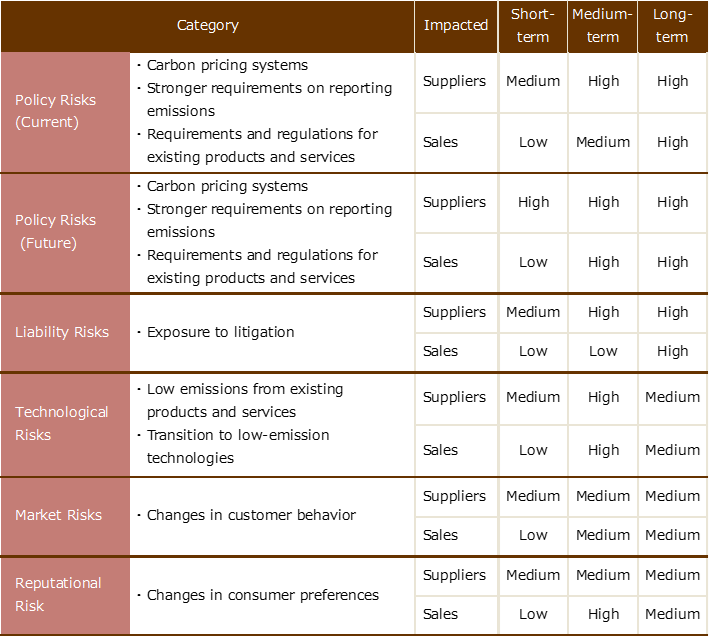
a. Transition Risks (1.5°C scenario, Reference: Net Zero Emissions by 2050 Scenario (NZE))
Transition risks include anticipated impacts on procurement due to existing and new regulations. Our group's main suppliers, the information and communications industries, have significant CO2 emissions due to electricity use, and with the GX-ETS (Green Transformation Emissions Trading Scheme) set to begin in 2026, there is a high probability that this will negatively impact their business performance. As a result, the risks posed by the new regulations have increased in the short, medium, and long term. Furthermore, because our sales are heavily reliant on personal services, such as the purchase of game software and in-app purchases in mobile games, the impact of stricter regulations on our group's products and services will be greater in the medium to long term. Regarding technological risks, the general shift towards low-carbon products and technologies will increase the risk in the medium term for information and communications industries, as they will be required to improve server installations and other infrastructure. However, in the long term, we expect that some progress will be made in adapting to new technologies, so this impact will be moderately reduced. Reputational risk is expected to be high in the medium term due to the risks to the credibility of our group with individual customers and shareholders, as well as risks to consumer preferences, in relation to our group's climate change initiatives. However, in the long term, technological advancements are expected to reduce these risks. To mitigate these increasing risks, our group has set greenhouse gas emission reduction targets for fiscal year 2030 as the target year within the medium-term period, as described in ③ Indicators and Targets, and will continue our present efforts to reduce emissions.
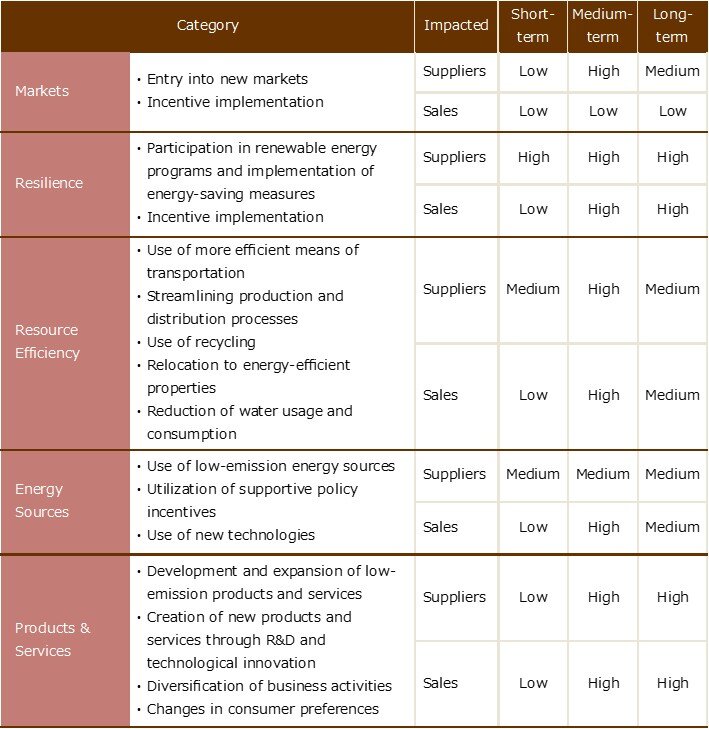
b. Opportunities (1.5°C scenario, Reference: Net Zero Emissions by 2050 Scenario (NZE))
Market: We predict it is highly likely that procurement costs will decrease in the medium term due to the advancement of incentive programs for major suppliers in the information and communications industries.
Resilience: We expect an increase in energy conservation and participation in renewable energy programs, and given the high energy consumption of game platform companies, which are among our main suppliers, there is a high probability that this will benefit us in the medium term.
Resource Efficiency: We predict that both the digitalization of production methods, such as the shift from physical package to online sales, and the increased efficiency of transportation methods, will have a significant impact on resource efficiency, leading to a reduction in transportation and production costs and substantial benefits to the Group.
Energy Sources: The use of low-emission energy sources is likely to win us credibility from customers and shareholders in the medium term, but in the long term, these new energy sources are likely to become more common, resulting in moderate long-term opportunities.
Products & Services: Considering consumer preferences are constantly changing, we believe that opportunities will increase in the medium to long term if our Group provides products and services that produce low emissions.
c. Physical Risks (4°C scenario, Reference: IPCC RCP 8.5)
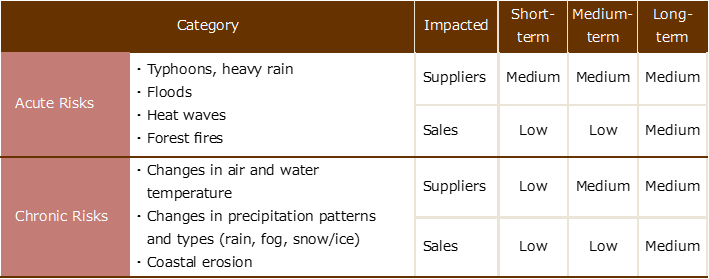
Acute Risks: We predict that acute risks such as droughts, heat waves, tornadoes, landslides, land subsidence, and wildfires, may affect our business performance.
On the supply side, we anticipate that information and communications companies, particularly game platform companies, and real estate companies, which currently account for a high proportion of our procurement, will be affected by floods, typhoons, heavy rains, and land subsidence over a period of several years to 15 years. Our group's clients in the information and communications industries face risks such as communication failures; the real estate industry is affected by factors such as a decline in property values and increased repair costs. We consider these to be moderate risks.
On the sales side, while it's unlikely that consumer game purchasing habits will be significantly affected by natural disasters within the next 10 years, we expect there will be impacts in the long term (more than 10 years) as the probability of natural disasters increases.
Chronic Risks: We predict that changes in temperature, changes in precipitation patterns, rising sea levels, heat stress, and ocean acidification will impact the performance of various connected industries. While the likelihood of chronic changes occurring within the next three years is low, we believe their impacts on our information and communications industry suppliers will gradually increase in the medium to long term, resulting in a moderate level of risk for our group. We expect sales to be moderately affected, given that the impact on personal services and the real estate industry, which account for a large proportion of our sales, will increase over the long term.
Quantitative risks based on climate change scenarios
Considering that game software development accounts for the majority of our group's business, we considered the impact of changes in electricity prices as a part of our quantitative analysis. We also calculated the impact of physical damage to our assets, taking into account our own real estate, such as buildings, company housing, and dormitories used by our group and its employees. The results of the below quantitative risk analysis have been reported to the Sustainability Committee and the Board of Directors, and we have assessed its impact to be limited.
The electricity price forecast is referenced from the DNE21 climate change mitigation assessment model from the Research Institute of Innovative Technology for the Earth (RITE). For physical damage to assets, we used the flood inundation risk estimation tool from the Japan Innovation Center of Civil Engineering (JICE) and the flood map from the Ministry of Land, Infrastructure, Transport and Tourism. Similar to the qualitative analysis, impact periods are defined as short-term (1-3 years), medium-term (3-10 years), and long-term (10-15 years). The degree of risk and opportunity (impact) is categorized by three levels: high if the impact on sales is 10% or more, medium if it is between 1% and 10%, and low if it is less than 1%.
a. Financial Impact of Changes in Electricity Prices
The Research Institute of Innovative Technology for the Earth (RITE)'s "Higher Emissions Scenario" predicts electricity price trends under a 1.5°C scenario, where carbon prices in major developed countries do not rise and technology does not advance as much as assumed in their "Growth Realization Scenario". Based on our baseline domestic electricity consumption for FY2023, and assuming no increase in electricity consumption, we expect a low impact of increased electricity costs in the short, medium, and long term; as such, we do not anticipate a significant impact on our group's medium- to long-term plans.
b. Financial Impact of Physical Damage to Assets
We calculated the estimated asset damage after climate change based on the flood depth of our group's offices under the 4°C scenario. Based on an analysis of the financial impact as a percentage of sales, we determined that none of the assets incurred any losses and therefore had no financial impact. We do not anticipate any negative impact on our group's medium- to long-term plans.
Indicators and Targets
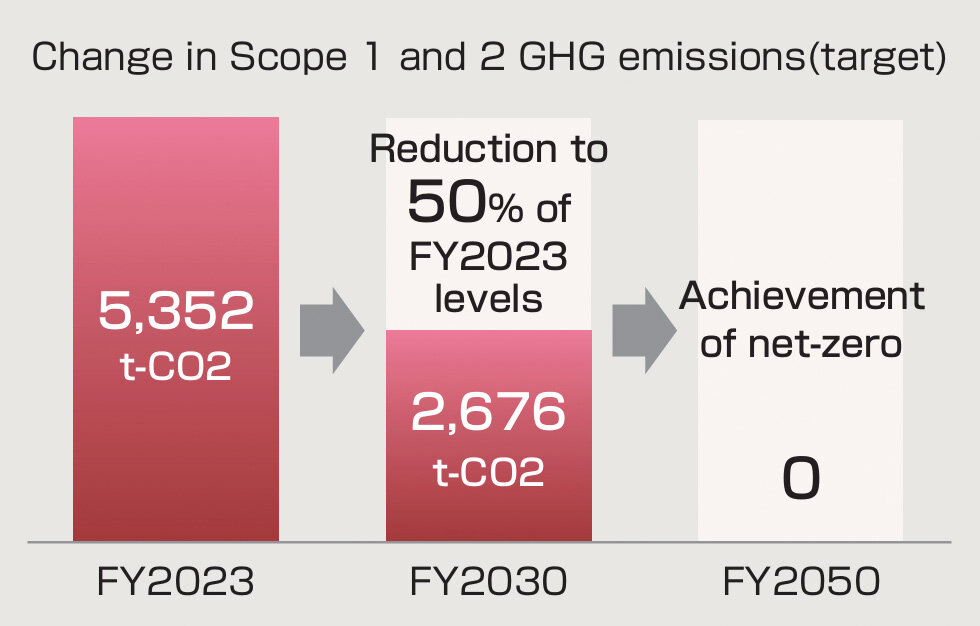
As part of our response to climate-related risks and opportunities, the group has set greenhouse gas (GHG) emissions as a key indicator and aims to reduce our own Scope 1 and 2 emissions by 50% by FY2030 compared to FY2023, and to achieve net zero emissions by FY2050. To achieve these goals, our Management Headquarters, primarily the Real Estate Department, which manages our group's assets, will consider countermeasures to be decided upon by the Sustainability Committee. We will also promote energy conservation measures and purchase more renewable energy.
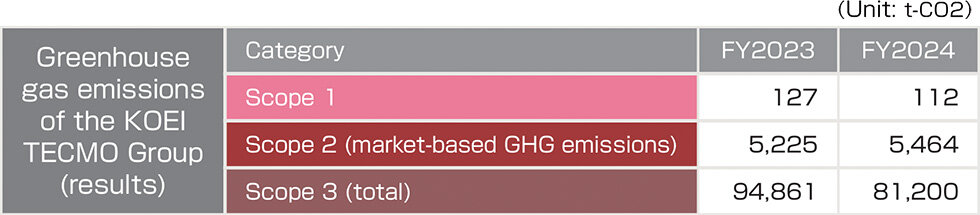
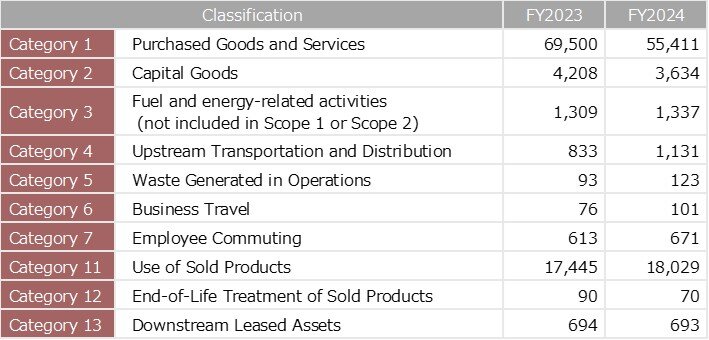
Scope 3 Breakdown by Category
(Notes)
1. Calculation scope: Consolidated subsidiaries in Japan and overseas
2. Calculations based on the General Guidelines on Supply Chain GHG Emission Accounting ver.2.5 published by the Japanese Ministry of the Environment & the Japanese Ministry of Economy, Trade and Industry.
3. Emissions from domestic electricity and fuel are calculated using emission coefficients in the Greenhouse Gas Emissions Calculation, Reporting, and Publication System published by Ministry of the Environment. Overseas electricity emissions are calculated using emission coefficients published by the governments of each country or the CDM database of the GES (Institute for Global Environmental Strategies).
4. Categories 8, 9, 10, 14, and 15 were not applicable.
5. Data for FY2023 is calculated from April 2023 to March 2024. Data for FY2024 is calculated from April 2024 to March 2025.
6. Our method for calculating GHG emissions changed in FY2024. Previous fiscal year calculations have been retroactively adjusted, and Scope 3 Category 1, 3, and 5 data have been changed to GHG.
Introduction of energy-saving equipment
We have implemented LED lighting for the office and water-conservative equipment for toilets and sinks.
Energy conservation through district heating and cooling systems
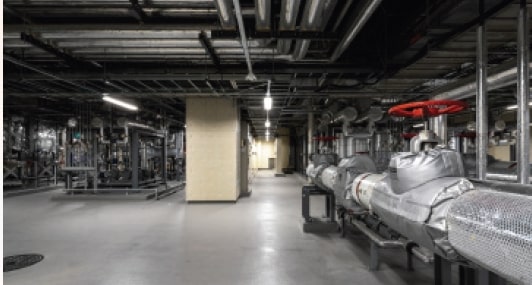
The Yokohama Minatomirai district promotes energy-saving and environmentally friendly urban development by introducing a district heating and cooling system in which cold water and steam used for heating, cooling, and hot water supply are centrally produced at an energy plant and supplied to facilities in the area. Through the implementation of this district air conditioning system, energy-efficient city development has been able to proceed with a low impact on the environment. At the KT Building, we combine this system with under-floor air conditioning that pushes air upward across the entire floor to implement an even more energy-efficient and effective air conditioning.
Greening Initiatives
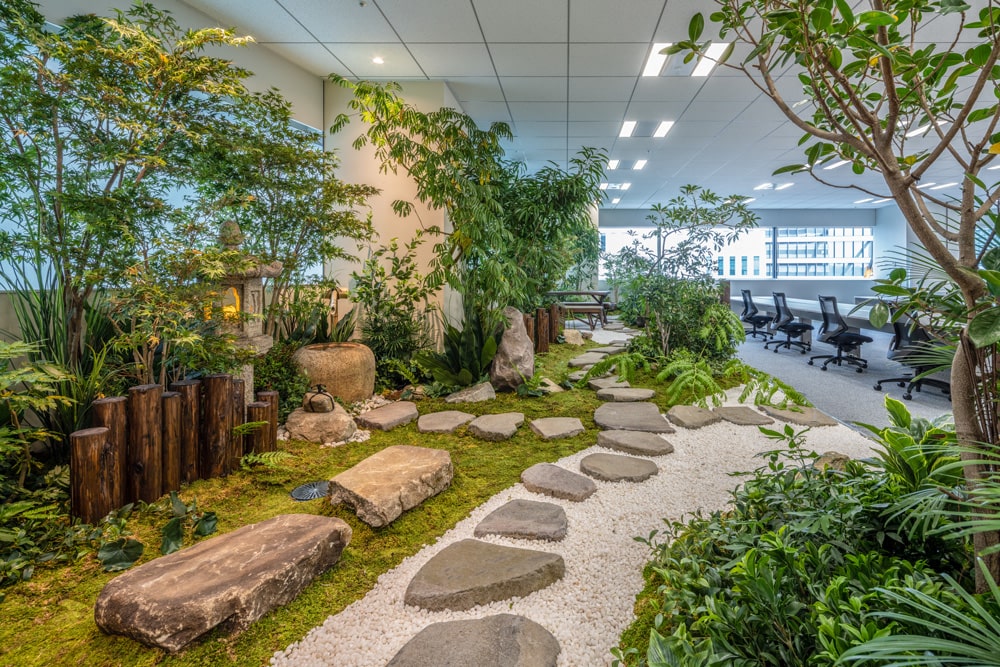
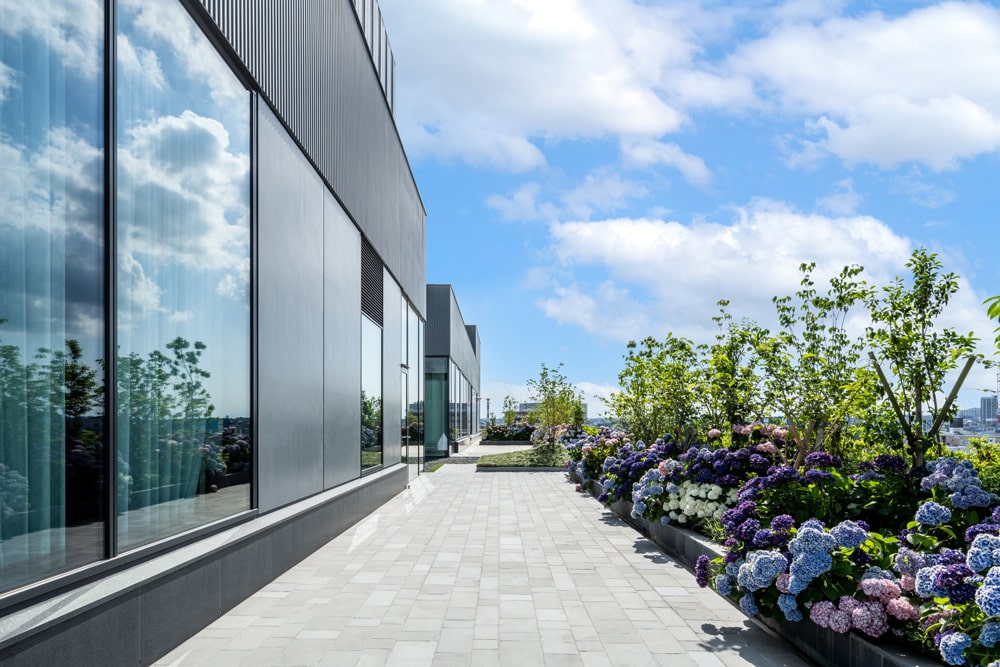
We have added a variety of greenery to the outer walls and exterior grounds to create a vibrant and environmentally friendly city scenery. In the office, indoor gardens with live plants have been installed on each floor to create a comfortable and creative work environment.
Accomplishments
- Energy-efficient office environment
- Implementation of district-based air conditioning system (KT Building).
- Implementation of flooring materials that are compliant with the Green Purchasing Law.
- Greening of company buildings
- Introducing plants to office.
- Monitoring of Electricity Consumption
- Monitoring electricity consumption of 4 main offices (Hiyoshi main office, No. 2 Building, Gemini Building, and KT Building).
- Contribution to decarburization and CO2 reduction through the introduction of high efficiency IT equipment and power saving
- Integrated and virtualized outdated physical servers, moving to a cloud environment.
- Paperless company meetings
- Board of Directors meetings and management meetings are now paperless.
- Electricity conservation through promotion of server virtualization and systemization
- Developed and implemented original communication tools and game development support systems that provide workflow support while maintaining a high level of security.
- Transitioned game development support tools from physical servers to virtual environments.
- Integrated and virtualized outdated physical servers, moving to a cloud environment.
- Digitization of game manuals
- Transition to digitization.
- Further paper conservation through DX
- Utilization of digital invoice system.
- Introduction of marketable securities management system.
- Utilization of digital contract system.
- Implementation of paperless workflow for game monitoring operations.
- Expansion of donations, investments, and support activities for environment-related projects
- Donated to the Yamashina Institute for Ornithology and the Keidanren Nature Conservation Fund.
- Expanding Cool Biz and Warm Biz
- Adopted an-all-year-round no-necktie policy.